Studying Atomic Nuclei while Reaching for the Stars
Exploring the synergy between nuclear physics and astrophysics has always been a core mission of nuclear science. Florida State University hosts strong groups in experimental and theoretical low-energy nuclear physics, as well as in astrophysics and astronomy, which work synergetically to tackle the open questions at the crossroads of these disciplines. The programs are funded by the Department of Energy (DOE) and the National Science Foundation (NSF). FSU plays a major role in the FRIB Theory Alliance. Besides performing experiments at different national and international facilities, the experimental nuclear physics group runs the John D. Fox Superconducting Linear Accelerator Laboratory located on the FSU campus. Operations of the laboratory are funded through the NSF. The Fox Laboratory is part of the Association for Research with University Nuclear Accelerators (ARUNA) and of the Center for Excellence in Nuclear Training and University-Based Research (CENTAUR).
Graduate Studies in Nuclear Structure and Nuclear Astrophysics
Become a part of our team. Exciting research projects are waiting for you. To find out more, contact our faculty (see Personnel → Faculty). To apply as a gradudate student in the Physics Program at Florida State University, click here.
FSU graduates talk about their graduate-research experience at the Fox Lab.
Dr. Maria Anastasiou (Supervisor: I. Wiedenhöver)
Dr. Kalisa Villafana (Supervisor: M. Riley)
Featured Research
A detailed view at nuclear magnetism
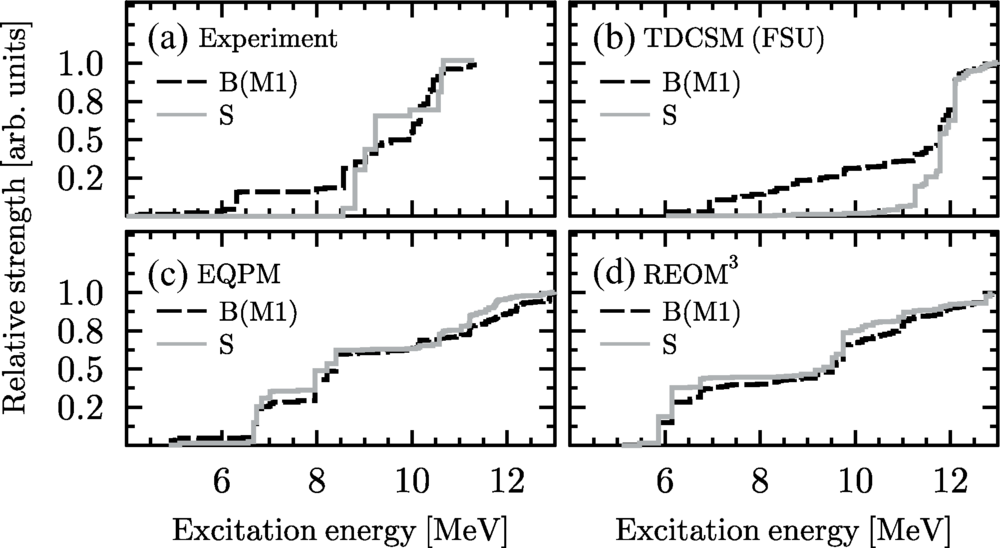
Magnetic dipole, M1, strengths were studied in semi-magic 50Ti up to the neutron-separation threshold by combining data from (d,p) one-neutron transfer, (γ,γ') real-photon scattering, (e,e') inelastic scattering at extreme backward angles, and (p,p') at Ep = 210 MeV and extreme forward angles. The combination of all probes provided the international team around FSU graduate student Bryan Kelly, FSU Associate Professor Mark Spieker, and FSU Professor Alexander Volya with unique access to the neutron spin-flip contribution and the possibility to evaluate its role in generating the spin-flip M1 strengths in the N=28 isotone 50Ti. The small contribution of the neutron (1f7/2)−1(1f5/2)+1 spin-flip transitions, which were probed with the (d,p) reaction, to the overall strength in 50Ti questions the standard picture for the microscopic origin of spin-flip strength in the fp shell. For 50Ti, the team showed that 1+ states with larger neutron (1f7/2)−1(1f5/2)+1 spectroscopic factors do not correspond to the ones with the largest B(M1;0+ → 1+) strengths. The results were published in Physical Review Letters.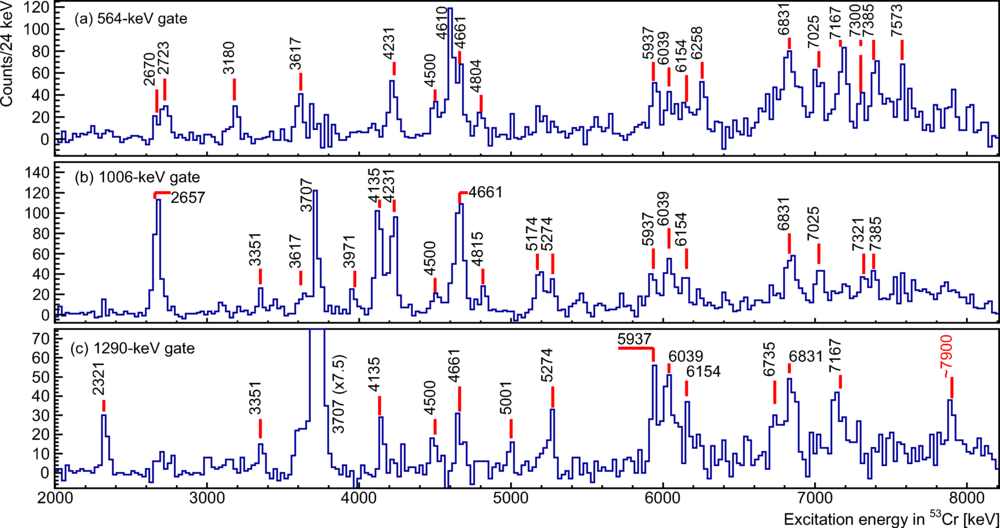
CeBrA informs detailed (d,p) study of 53Cr
Professor Spieker and his collaborators used the CeBr3 Array (CeBrA) demonstrator for a detailed study of the neutron-adding strength to the N=28 isotone 52Cr. In a particle-gamma coincidence experiment with CeBrA and the SE-SPS, excited states in 53Cr were studied via the 52Cr(d,pγ) reaction up to the neutron-separation threshold. Proton-γ angular correlations and γ decay branching ratios were measured, that provided crucial complementary information for probing single-particle strengths in 53Cr. In particular, higher-lying excited states could be assigned to 53Cr because overlapping excited states and contaminants could be identified better thanks to the complementary γ-decay information. This study, published in Physical Review C, is another example for the additional selectivity that CeBrA provides for the spectroscopy of atomic nuclei.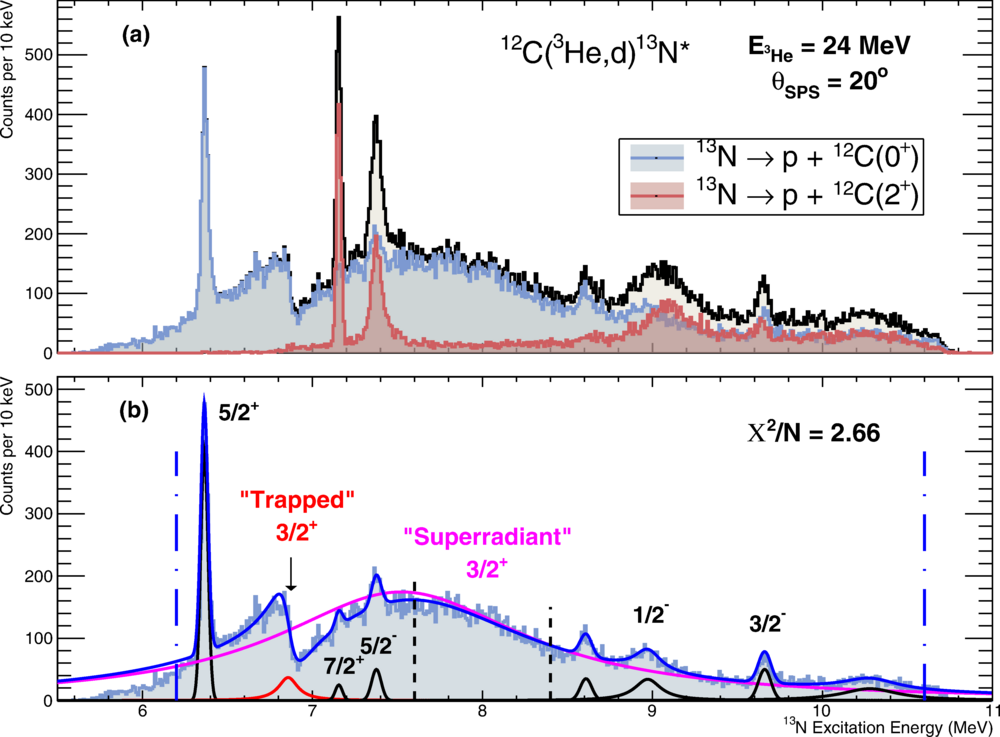
Decay of the proton-unbound superradiant state in 13N
In this paper, FSU alumn Ken Hanselman, Professor Wiedenhoever, and their colleagues studied the proton-unbound superradiant state in 13N via the 12C(3He,d)13N reaction. The experiment was performed at the FSU SE-SPS and used an array of silicon detectors to detect protons from proton-unbound states in 13N. The silicon array surrounded the target, allowing for the measurement of angular correlations. A formalism describing the spin polarization of direct reactions was developed to analyze these correlations, and was verified on the known directionally asymmetric decay distributions arising from parity mixing in the 13N(3/2−,5/2+) doublet. The same formalism was then used to study the decays from the continuum-aligned, broad 3/2+ resonance at 7.9 MeV excitation energy, which arises from superradiant coupling. Hanselman and his collaborators showed that the observed asymmetric angular correlation patterns could approximately be reproduced by adding an “artificial” 3/2− resonance. The parity-mixing approach presented in this article, that was published in Physical Review C, serves as a first approximation to a more advanced reaction model of rapid reaction and decay sequences.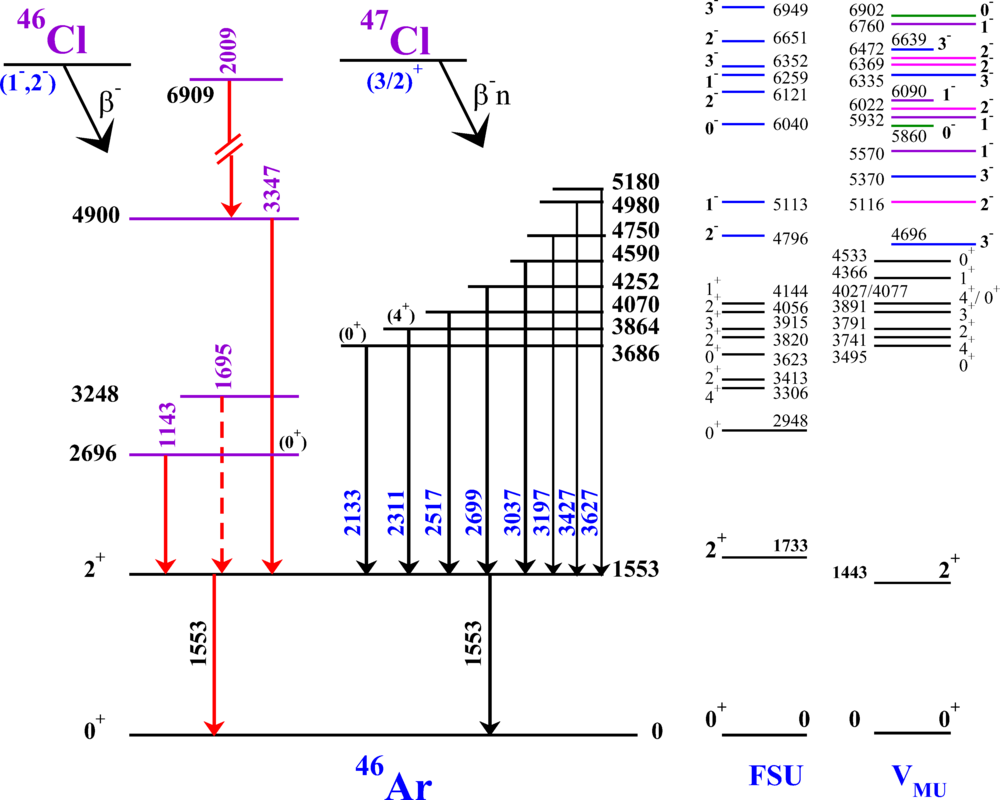
Exploring β decay and β-delayed neutron emission in exotic 46,47Cl isotopes
In this paper, which Professor Tripathi and her collaborators published in Physical Review C, β- and β-delayed neutron decays of 46,47Cl are reported from an experiment carried out at the National Superconducting Cyclotron Laboratory using the Beta Counting System. The half-lives of both 46Cl and 47Cl were extracted. Based on the delayed γ-ray transitions observed, the level structure of N = 28 46Ar was determined. Completely different sets of excited states above the first 2+ state in 46Ar were populated in the 46Cl β0n and 47Cl β1n decay channels. Two new γ-ray transitions in 47Ar were identified from the very weak 47Cl β0n decay. Furthermore, 46Cl β1n and 47Cl β2n were also observed to yield different population patterns for levels in 45Ar, including states of different parities. The experimental results allow Professor Tripathi and her collaborators to address some of the open questions related to the delayed neutron emission process. For isotopes with large neutron excess and high Qβ values, delayed neutron emission remains an important decay mode and can be utilized as a powerful spectroscopic tool. Experimental results were compared with shell-model calculations using the FSU and VMU effective interactions.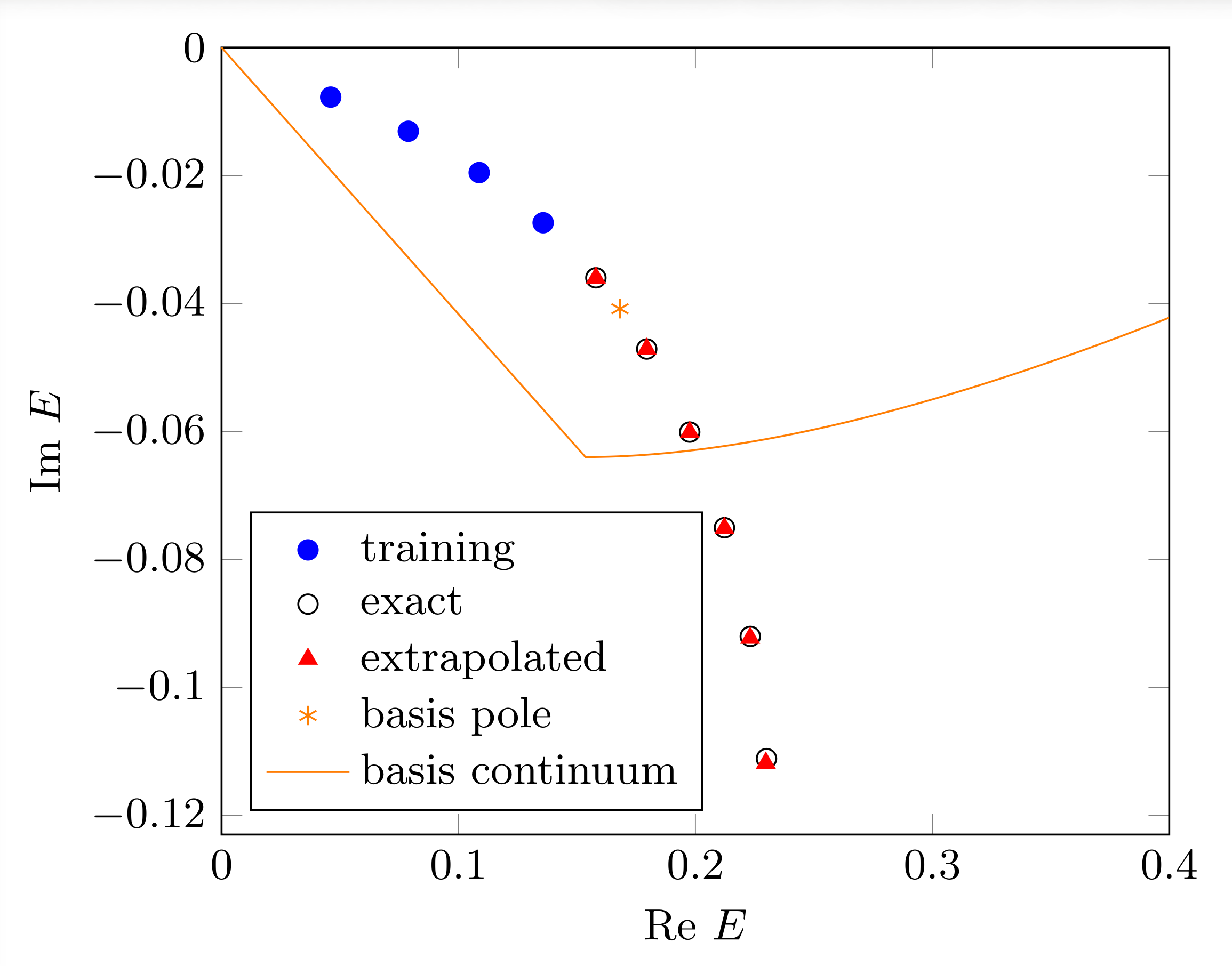
Toward scalable bound-to-resonance extrapolations for few- and many-body systems
As members of the STREAMLINE 2 collaboration for the advancement of AI/ML techniques in nuclear theory, Dr. Nuwan Yapa (FSU), Prof. K. Fossez (FSU), and Prof. S. König (North Carolina State University) have demonstrated that reliable bound-to-resonance extrapolations can be performed for genuine three-body resonances such as the ground state of 6He. This work, published in Physical Review C, generalizes the complex-augmented eigenvector continuation (CA-EC) method introduced by the same team two years earlier, and paves the way toward scalable resonance extrapolations in many-body systems. In the future, the method will be applied to exotic states of experimental interest.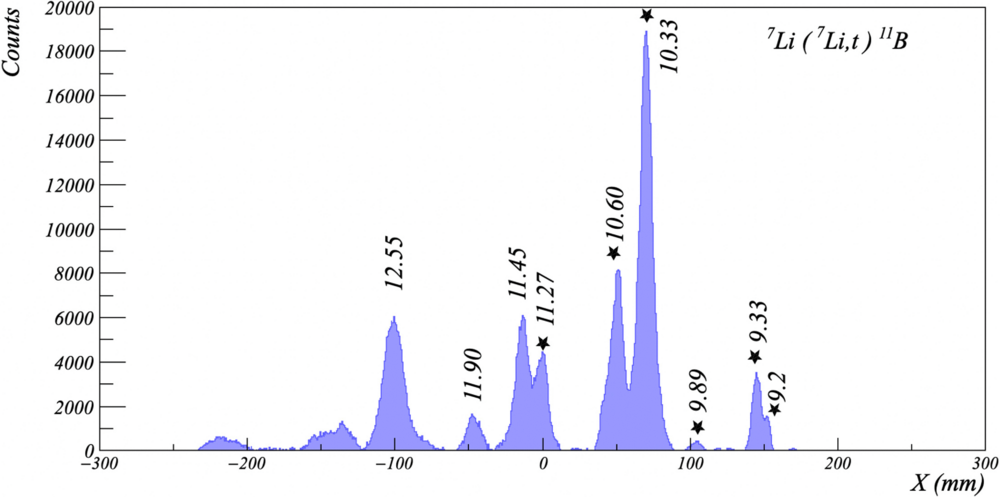
Study of alpha resonances in 11B via the 7Li(7Li,t) reaction
The near-threshold proton resonance in 11B, recently identified and characterized through independent experiments, plays a crucial role in understanding the unexpectedly high decay branch observed in the β-delayed proton emission (β−p) from the neutron halo nucleus 11Be. Critical to interpreting this process is the determination of whether or not this state has any significant α-decay width (Γα). A coincidence measurement was conducted to study the alpha-transfer reaction 7Li(7Li,t)11B* → 7Li+α employing the Super-Enge Split Pole Spectrograph coupled with a silicon detector at Florida State University. The experiment aimed to investigate the structure of α resonances in 11B in the Ex = 9.0 MeV to 14 MeV energy region. In particular, to explore and constrain the α-decay branch of the near-threshold proton resonance at Ex = 11.44 MeV. No significant α-decay strength was observed from this state. Additionally, the experimental results provided insights into the state at Ex = 12.55 MeV, previously proposed as the T = 3/2 isobaric analog state of the 11Be ground state. The observed decay pattern, dominated by α+7Li, suggests a strong T = 1/2 component, indicating the need for further experimental measurements. Spearheaded by Professor Almaraz-Calderon's former student, Eilens Lopez Saavedra, the result were published in Physical Review C.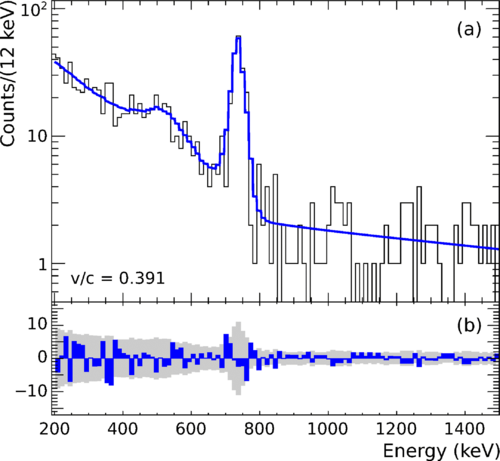
Determination of proton and neutron contributions to the 0+(g.s.)→2+(1) excitations in 42Si and 44S
A collaboration, led by Ursinus College Professor Lew Riley and including Professors Cottle, Spieker, and Volya, has measured the 0+(g.s.)→2+(1) transition in the neutron-rich N = 28 isotope 42Si using the probes of intermediate-energy Coulomb excitation and inelastic proton scattering in inverse kinematics at the Facility for Rare Isotope Beams (FRIB) with beam particle rates of about 5 particles/s. The results of these two measurements allowed them to determine Mn/Mp, the ratio of the neutron and proton transition matrix elements for the 0+(g.s.)→2+(1) transition. In addition, the collaboration measured the 0+(g.s.)→2+(1) transition in the isotone 44S using inverse kinematics inelastic proton scattering. By comparing the 44S proton-scattering result with a recent intermediate-energy Coulomb excitation result on the same transition, the group was able to determine Mn/Mp for the 0+(g.s.)→2+(1) transition in this nucleus as well. This work strengthens the evidence that 42Si has a stable quadrupole deformation in its ground state and that 44S does not. Both conclusions are further supported by shell-model calculations carried out with the FSU interaction. The results were published in Physical Review C.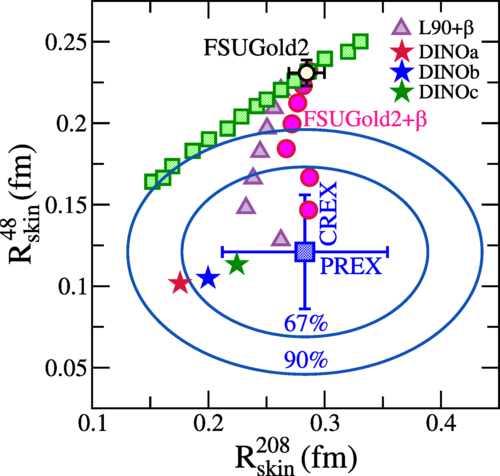
Role of the isovector spin-orbit potential in mitigating the CREX-PREX dilemma
Pioneering electroweak measurements of the neutron skin thickness in lead-208 and calcium-48 are challenging our understanding of nuclear dynamics. Many theoretical models suggest that the slope of the symmetry energy controls the development of a neutron skin in neutron-rich nuclei. This led to the expectation that if lead-208 exhibits a large neutron skin, calcium-48 should as well. Given that the PREX Collaboration reported a relatively thick neutron skin in lead, we anticipated that calcium would also have a significant neutron skin. Instead, the CREX Collaboration reported a thin neutron skin in calcium. Although many suggestions have been proposed, the “CREX-PREX dilemma” remains unsolved. Recently, an intriguing scenario has emerged, suggesting that an enhanced isovector spin-orbit interaction could simultaneously account for both results. Following this approach, Professor Piekariewicz and his graduate students, Athul Kunjipurayil and Marc Salinas, performed relativistic mean-field calculations with an increased isovector spin-orbit potential. Their findings indicate that, while this modification significantly affects the structure of calcium-48, it has only a marginal impact on lead-208, thereby bringing the results into better agreement with experiment. However, the strong enhancement required to mitigate the CREX-PREX dilemma destroys the agreement with a successful spin-orbit phenomenology, primarily by modifying the well-known ordering of spin-orbit partners. The results were published in Physical Review C as an Editors' Suggestion.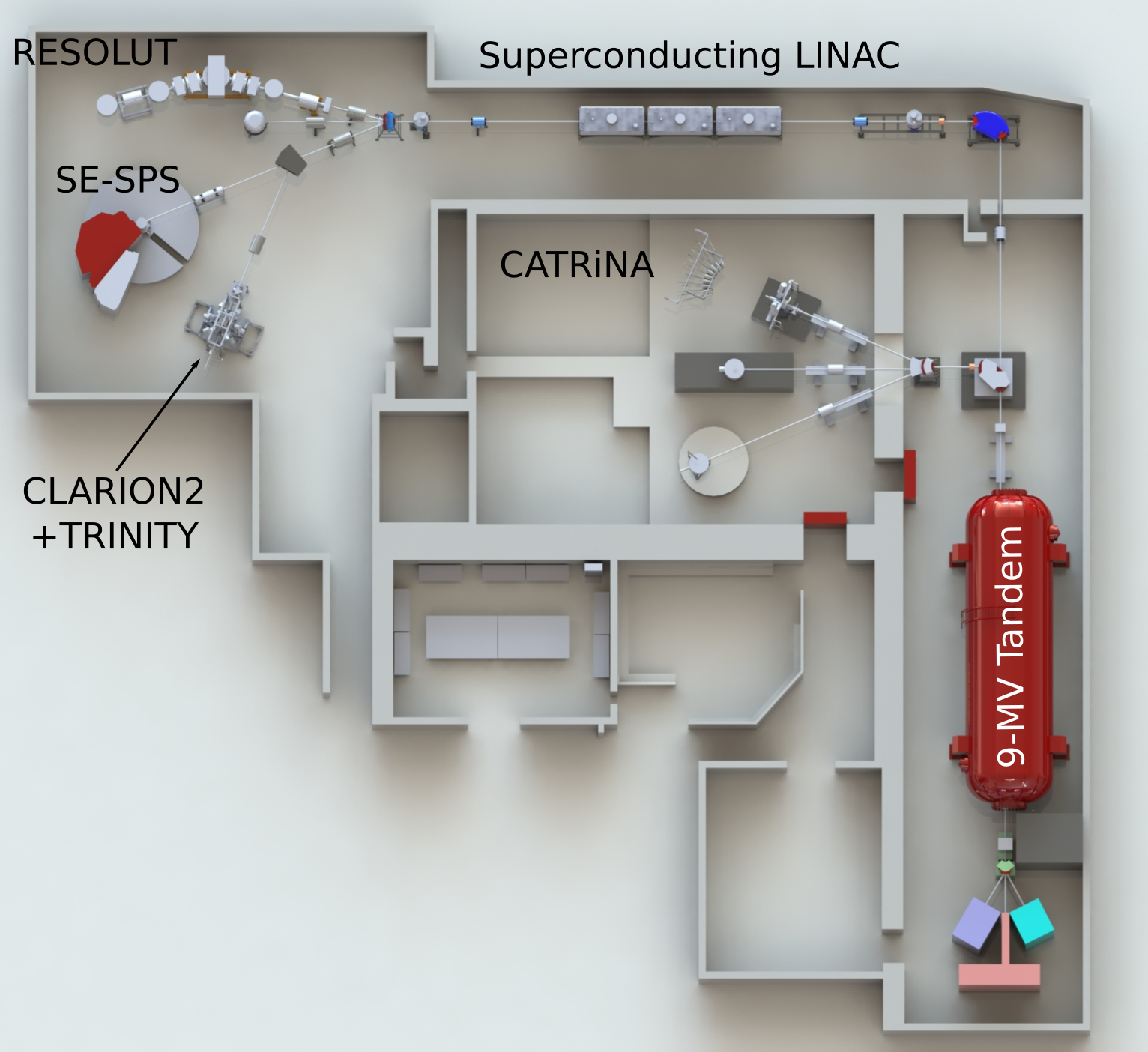
Particle-γ coincidence experiments at Fox Lab
Since its foundation in the 1960s, the John D. Fox Superconducting Linear Accelerator Laboratory at Florida State University (FSU) pursued research at the forefront of nuclear science. In this invited contribution, Dr. Almaraz-Calderon and Dr. Spieker present recent highlights from nuclear structure and reaction studies conducted at the John D. Fox Superconducting Linear Accelerator Laboratory, also featuring the general experimental capabilities at the laboratory for particle-γ coincidence experiments. Specifically, they focus on light-ion induced reactions measured with the Super-Enge Split-Pole Spectrograph (SE-SPS) and the CATRiNA neutron detectors, respectively. Some results obtained with the CeBrA demonstrator for particle-γ coincidence experiments at the SE-SPS are presented. A highlight from the first experimental campaigns with the combined CLARION2-TRINITY setup, showing that weak reaction channels can be selected, is discussed as well. The results were published as part of the topical issue "Modern Advances in Direct Reactions for Nuclear Structure" in Frontiers in Physics, Section Nuclear Physics.
Recent News and Highlights
Fox Lab featured in Spectrum Magazine
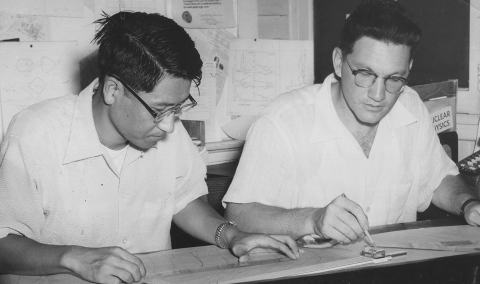
The FSU College of Arts and Sciences featured the 65-year long history of our laboratory and nuclear physics at FSU in the new edition of the Spectrum Magazine. As highlighted by author McKenzie Harris, since the 1960's, the Fox Lab’s nuclear structure and nuclear astrophysics scholars have made critical advances in nuclear science by studying the quantum mechanics of atomic nuclei and their reactions, which also supports applications like medical treatments, energy production and storage, national security, and more while preparing tomorrow’s talented scientists for a wide range of work opportunities across varied industries. For the story, Professors Wiedenhoever, Fossez, Tripathi, Cottle, and Kemper, as well as some of our current graduate students were interviewed. You can read the story here.
FSU hosted COMEX8
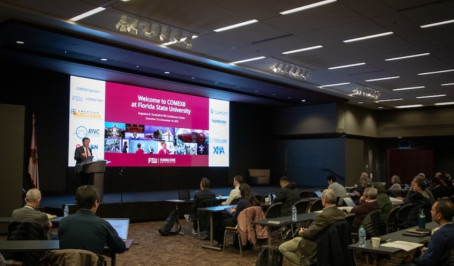
The low-energy nuclear physics group at FSU had the honor to organize and host the 8th international conference on collective motion in nuclei under extreme conditions (COMEX8) from December 15 to December 19, 2025. The conference was held at the Augustus B. Turnbull III Florida State Conference Center. Around 100 participants visited Tallahassee and contributed to the week-long conference, presenting new exciting results at the frontiers of nuclear physics. We want to use this opportunity to also thank our sponsors, including support from Florida State University, without whom this event could not have succeeded. The ninth edition of COMEX will be organized by the Osaka group in Japan.
NSF MRI funding for CeBrA
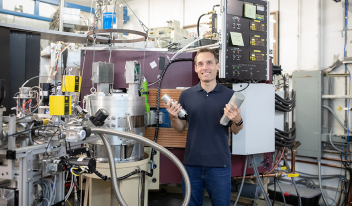
Professors Lewis A. Riley from Ursinus College, Andrea Richard from Ohio University, and Mark-Christoph Spieker from Florida State University have received a $721,072 Major Research Instrumentation grant from the U.S. National Science Foundation to complete the Cerium Bromide Array (CeBrA) for particle-gamma coincidence experiments at the FSU SE-SPS of the John D. Fox Laboratory. The grant allows the team to add nine additional CeBr3 detectors to the current array of five, paving the way for selective nuclear-structure experiments and collaborative physics research with other institutions. Follow the links to read the announcements by Ursinus College and Florida State University.
Fox Lab awarded $9M grant by NSF
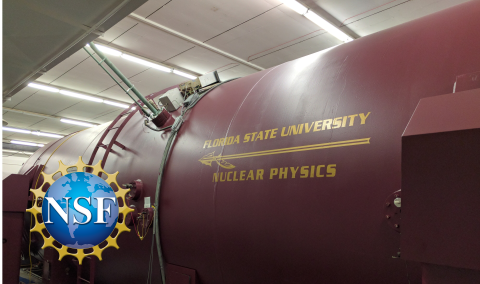
The Fox Laboratory has received a USD 9 million grant from the National Science Foundation to continue its cutting-edge research in nuclear physics and nuclear astrophysics. The grant supports the operation of the on-campus John D. Fox Accelerator Laboratory and the research programs of Professors Ingo Wiedenhoever (PI), Sergio Almaraz-Calderon (Co-PI), Paul Cottle (Co-PI), Mark-Christoph Spieker (Co-PI), Samuel Tabor (Co-PI), and Vandana Tripathi (Co-PI). The award abstract and information can be found here.
Piekarewicz co-organizes Talent School at ECT*
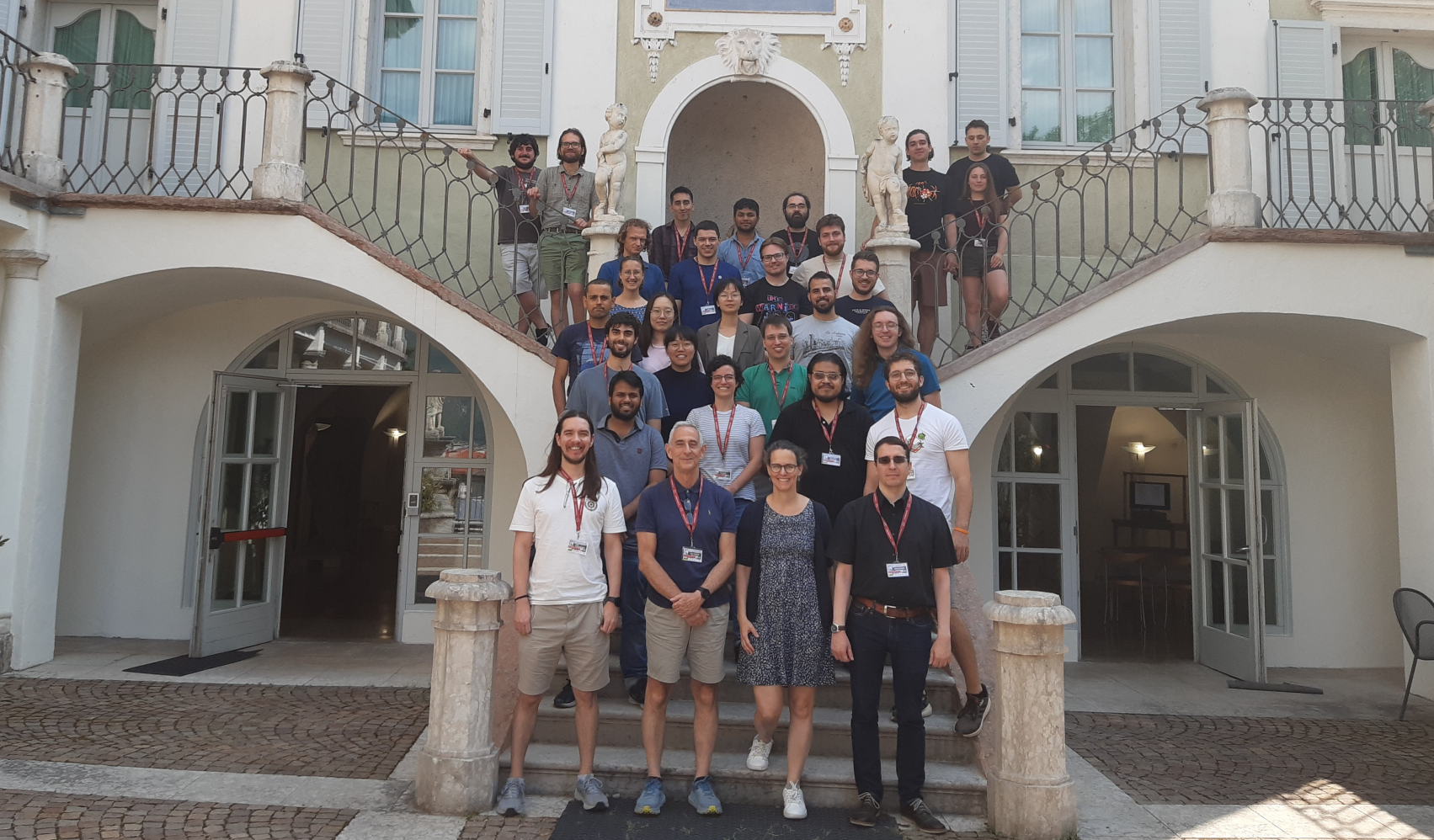
The DTP/TALENT 2024 School on Nuclear Theory for Astrophysics took place from July 15 to August 2, 2024 at the ECT* in Trento, Italy. FSU professor Jorge Piekarewicz was one of the main organizers and lecturers. The goal of the school was to provide the attendees with high level training on nuclear physics and nuclear astrophysics from various perspectives that include the Equation of State (EOS), neutron star mergers, and supernovae – and their combined impact in spearheading the brand new era of multi-messenger astronomy. In addition to Professor Piekarewicz, Almudena Arcones, Bruno Giacomazzo, as well as other experts in the various fields of relevance to the school were among the key lecturers. For more information, click here.
Wiedenhoever named Distinguished Research Professor
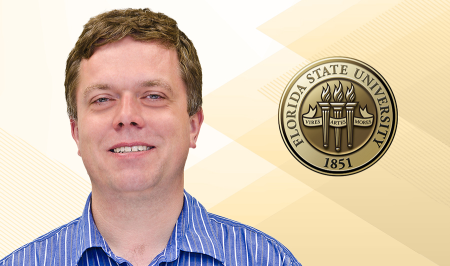
Florida State University has bestowed the title of Distinguished Research Professor on four outstanding faculty members for their exemplary research productivity and contributions to their fields. "Outstanding national and international scholarly output and creativity is a cornerstone of a thriving research enterprise," said Vice President for Research Stacey S. Patterson. "I am thrilled to be able to recognize four individuals as Distinguished Research Professors this year who model exceptional performance and extraordinary contributions to their fields." The Distinguished Research Professor award recognizes outstanding research and/or creative activity of eligible Florida State University faculty currently at the rank of full professor. Among the four 2024 recipients of the Distinguished Research Professor Award is Fox Laboratory Director Professor Ingo Wiedenhoever. Congratulations! Read more here.
Fox Lab student selected for student highlight
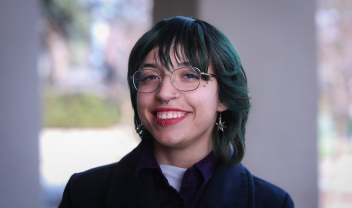
The FSU College of Arts and Sciences has selected Ana Pereira, a third year undergraduate in the Department of Physics, for a student highlight. Ana works with Professor Tripathi on an undergraduate research project on induced fission. Ana has presented their findings at FSU's 2024 Undergraduate Research Symposium and during the 2024 President’s Showcase of Undergraduate Research Excellence. Read more about Ana's spotlight interview and their participation in the 2024 President’s Showcase.
Fox Lab feature on Fox13 Tampa Bay
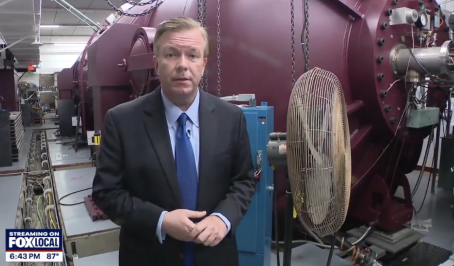
Professors Almaraz-Calderon, Cottle, and Wiedenhoever recently talked with "breakthroughs in science" host Craig Patrick for his segment on Fox13 Tampa Bay. The feature, which also mentions the planned collaboration with Mayo Clinic to develop improved methods of treating cancer, can be found here.
Cottle on Florida's STEM education
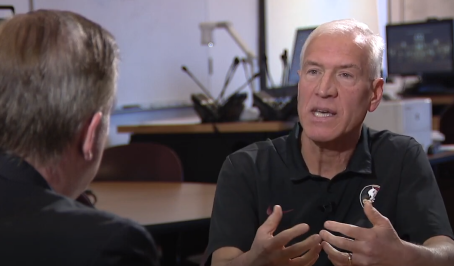
Paul Cottle was interviewed by 20-time Emmy winner Craig Patrick of Tampa Bay's Fox 13 for his show "Money, Power and Politics" about Florida's shortcomings in preparing high school students for college STEM majors, including physics, engineering and computing. The segment was broadcast in March 2024 and can be found on YouTube. Cottle was also invited by the Palm Beach County School District (the nation's tenth largest school district with about 200,000 students) to speak to high school students about how to best prepare for college majors in STEM fields, including physics, engineering and computing. Professor Cottle spoke to a live audience at John I. Leonard High School and reached many more through the district's live stream of the talk to high schools throughout Palm Beach County on March 14, 2024, which is available on YouTube.