ANASEN
Array for Nuclear Astrophysics and Structure with Exotic Nuclei (ANASEN) is an active target detector. FSU, LSU, and TAM are joined in the development of the project.
First Generation
NIM paper : https://doi.org/10.1016/j.nima.2017.07.030 PRC paper : https://doi.org/10.1103/PhysRevC.105.055806
Second Generation
The main difference from the 1st generation is the Twisted Anode and Cathode wires.
Basics Geometry
There are 5 Layers on the radial position of the ANASEN.
| Structure | Radius [mm] |
|---|---|
| ionizing wires | 23 |
| Guard wires | 33 |
| Anode wires | 38 |
| Cathode wires | 43 |
| SuperX3 Silicon | 88 |
Twisted Anode and Cathodes
Readout
SuperX3 Silicon Detector Array
There are 24 Super-X3 double-sided Silicon detectors on the wall of the ANASEN. They are placed 88 mm away from the beam axis. Each of them has 75 mm X 40 mm sensitive area. Thus, the super-X3 covers a forward and backward angle of 40 deg.
Readout
On the front side, each strip has 2 readouts. On the back side, each strip has 1 readout for total energy.
Tracking for the twisted wire configuration
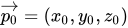
A beam trace consists of 5 parameters: 3 from a point Failed to parse (SVG with PNG fallback (MathML can be enabled via browser plugin): Invalid response ("Math extension cannot connect to Restbase.") from server "https://wikimedia.org/api/rest_v1/":): {\displaystyle (x_0, y_0, z_0)} and 2 from the trace angle . Thus, to reconstruct the beam trace, we need at least 5 pieces of information.
Suppose we know the position on the SuperX3, thus, we have 3 pieces of information Failed to parse (SVG with PNG fallback (MathML can be enabled via browser plugin): Invalid response ("Math extension cannot connect to Restbase.") from server "https://wikimedia.org/api/rest_v1/":): {\displaystyle \vec{p_0} = (x_0, y_0, z_0)} . And We have 2 wires ID. Each wire and the Failed to parse (SVG with PNG fallback (MathML can be enabled via browser plugin): Invalid response ("Math extension cannot connect to Restbase.") from server "https://wikimedia.org/api/rest_v1/":): {\displaystyle \vec{p_0} } will form a plan, the intersection line of the 2 plans will give us the first approximation of the beam trace.
Each wire is constructed from 2 points, let them be Failed to parse (SVG with PNG fallback (MathML can be enabled via browser plugin): Invalid response ("Math extension cannot connect to Restbase.") from server "https://wikimedia.org/api/rest_v1/":): {\displaystyle \vec{a_i} } and Failed to parse (SVG with PNG fallback (MathML can be enabled via browser plugin): Invalid response ("Math extension cannot connect to Restbase.") from server "https://wikimedia.org/api/rest_v1/":): {\displaystyle \vec{b_i} } , where Failed to parse (SVG with PNG fallback (MathML can be enabled via browser plugin): Invalid response ("Math extension cannot connect to Restbase.") from server "https://wikimedia.org/api/rest_v1/":): {\displaystyle i } is the wire ID. The plane formed by the points Failed to parse (SVG with PNG fallback (MathML can be enabled via browser plugin): Invalid response ("Math extension cannot connect to Restbase.") from server "https://wikimedia.org/api/rest_v1/":): {\displaystyle \vec{p_0}, \vec{a_i}, \vec{b_i} } has normal Failed to parse (SVG with PNG fallback (MathML can be enabled via browser plugin): Invalid response ("Math extension cannot connect to Restbase.") from server "https://wikimedia.org/api/rest_v1/":): {\displaystyle \vec{n_i} = (\vec{p_0} - \vec{a_i}) \times (\vec{p_0} - \vec{b_i}) } . The vector for the line intersects between the 2 planes constructed by wire ID Failed to parse (SVG with PNG fallback (MathML can be enabled via browser plugin): Invalid response ("Math extension cannot connect to Restbase.") from server "https://wikimedia.org/api/rest_v1/":): {\displaystyle i, j} and point </math> \vec{p_0}</math> is Failed to parse (SVG with PNG fallback (MathML can be enabled via browser plugin): Invalid response ("Math extension cannot connect to Restbase.") from server "https://wikimedia.org/api/rest_v1/":): {\displaystyle \vec{N_{ij}} = \vec{n_i} \times \vec{n_j} : (\theta, \phi)} . Thus, the beam trace has an equation of Failed to parse (SVG with PNG fallback (MathML can be enabled via browser plugin): Invalid response ("Math extension cannot connect to Restbase.") from server "https://wikimedia.org/api/rest_v1/":): {\displaystyle \vec{r} = \vec{p_0} + s \vec{N_{ij}} } , where Failed to parse (SVG with PNG fallback (MathML can be enabled via browser plugin): Invalid response ("Math extension cannot connect to Restbase.") from server "https://wikimedia.org/api/rest_v1/":): {\displaystyle s } is the coordinate on the line.
uncertainty
Since the beam is not hit directly on the wires, but a distance Failed to parse (SVG with PNG fallback (MathML can be enabled via browser plugin): Invalid response ("Math extension cannot connect to Restbase.") from server "https://wikimedia.org/api/rest_v1/":): {\displaystyle d_i } from the wire. This will rotate the plane on Failed to parse (SVG with PNG fallback (MathML can be enabled via browser plugin): Invalid response ("Math extension cannot connect to Restbase.") from server "https://wikimedia.org/api/rest_v1/":): {\displaystyle \vec{p_0} } along the direction Failed to parse (SVG with PNG fallback (MathML can be enabled via browser plugin): Invalid response ("Math extension cannot connect to Restbase.") from server "https://wikimedia.org/api/rest_v1/":): {\displaystyle \vec{a_i} - \vec{b_i} } by Failed to parse (SVG with PNG fallback (MathML can be enabled via browser plugin): Invalid response ("Math extension cannot connect to Restbase.") from server "https://wikimedia.org/api/rest_v1/":): {\displaystyle \pm \arctan{d/l} } , where Failed to parse (SVG with PNG fallback (MathML can be enabled via browser plugin): Invalid response ("Math extension cannot connect to Restbase.") from server "https://wikimedia.org/api/rest_v1/":): {\displaystyle l } is the perpendicular distance of the point Failed to parse (SVG with PNG fallback (MathML can be enabled via browser plugin): Invalid response ("Math extension cannot connect to Restbase.") from server "https://wikimedia.org/api/rest_v1/":): {\displaystyle \vec{p_0} } and the line. This creates 2 additional planes with normal vectors that are rotated along the line by angle Failed to parse (SVG with PNG fallback (MathML can be enabled via browser plugin): Invalid response ("Math extension cannot connect to Restbase.") from server "https://wikimedia.org/api/rest_v1/":): {\displaystyle \pm \arctan{d/l} } . The 4 additional planes form the uncertainty boundaries of the beam. In other words, the normal vector of the plane has uncertainty Failed to parse (SVG with PNG fallback (MathML can be enabled via browser plugin): Invalid response ("Math extension cannot connect to Restbase.") from server "https://wikimedia.org/api/rest_v1/":): {\displaystyle \vec{n_i} \pm \vec{d_i} } that translates to the beam direction vector Failed to parse (SVG with PNG fallback (MathML can be enabled via browser plugin): Invalid response ("Math extension cannot connect to Restbase.") from server "https://wikimedia.org/api/rest_v1/":): {\displaystyle \vec{N_{ij}} : (\theta \pm \delta\theta, \phi \pm \delta\phi) } .
Additional uncertainty comes from the position of the SuperX3.
3D model and Simulation
A simulation code and 3D model using CERN root can be found https://fsunuc.physics.fsu.edu/git/rtang/ANASEN_analysis/src/branch/master/Armory.
The core is the ANASEN class (ClassAnasen.h). This class contains the geometry (the endpoints of the anode and cathode wire, the edges of the SuperX3). The class can simulate the anode and cathode wire and the position at the SuperX3 with a track. Or, it can deduce the track using the SuperX3, anode, and cathode information.
A Monte Carlo simulation is constructed with the TransferReaction class (ClassTransfer.h).